Report is a good foundation; now build the bridge
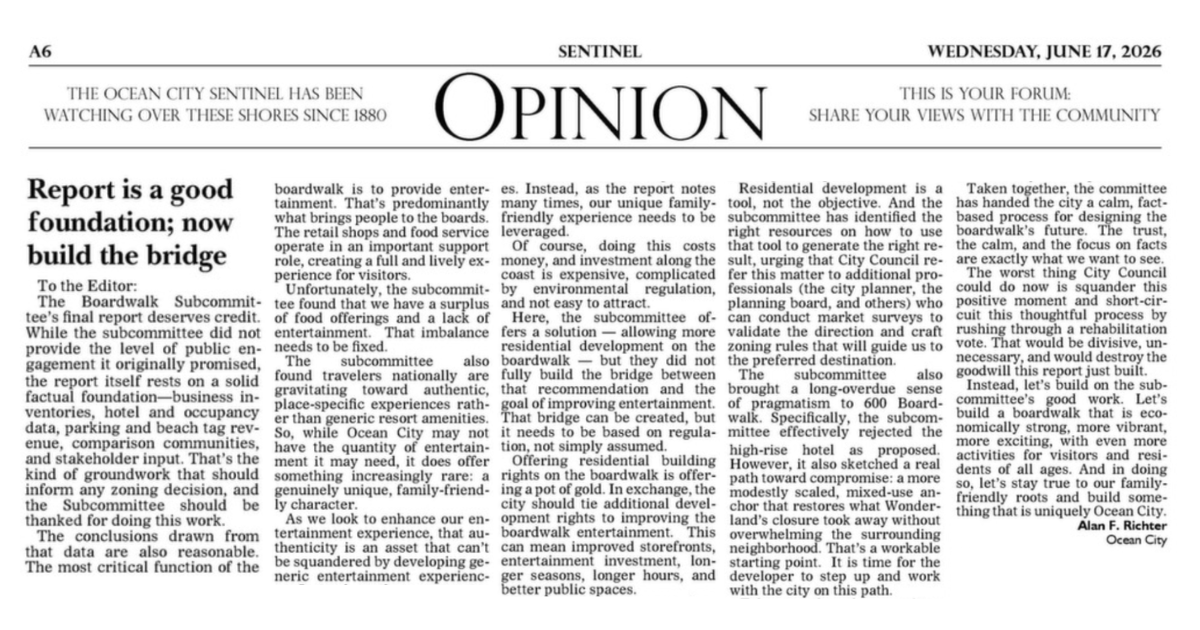
Originally published in Ocean City Sentinel
by Alan F. Richter
To the Editor:
The Boardwalk Subcommittee’s final report deserves credit. While the subcommittee did not provide the level of public engagement it originally promised, the report itself rests on a solid factual foundation—business inventories, hotel and occupancy data, parking and beach tag revenue, comparison communities, and stakeholder input. That's the kind of groundwork that should inform any zoning decision, and the Subcommittee should be thanked for doing this work.
The conclusions drawn from that data are also reasonable. The most critical function of the boardwalk is to provide entertainment. That's predominantly what brings people to the boards. The retail shops and food service operate in an important support role, creating a full and lively experience for visitors.
Unfortunately, the subcommittee found that we have a surplus of food offerings and a lack of entertainment. That imbalance needs to be fixed.
The subcommittee also found travelers nationally are gravitating toward authentic, place-specific experiences rather than generic resort amenities. So, while Ocean City may not have the quantity of entertainment it may need, it does offer something increasingly rare: a genuinely unique, family-friendly character.
As we look to enhance our entertainment experience, that authenticity is an asset that can't be squandered by developing generic entertainment experiences. Instead, as the report notes many times, our unique family-friendly experience needs to be leveraged.
Of course, doing this costs money, and investment along the coast is expensive, complicated by environmental regulation, and not easy to attract.
Here, the subcommittee offers a solution—allowing more residential development on the boardwalk—but they did not fully build the bridge between that recommendation and the goal of improving entertainment. That bridge can be created, but it needs to be based on regulation, not simply assumed.
Offering residential building rights on the boardwalk is offering a pot of gold. In exchange, the city should tie additional development rights to improving the boardwalk entertainment. This can mean improved storefronts, entertainment investment, longer seasons, longer hours, and better public spaces.
Residential development is a tool, not the objective. And the subcommittee has identified the right resources on how to use that tool to generate the right result, urging the City Council refer this matter to additional professionals (the city planner, the planning board, and others) who can conduct market surveys to validate the direction and craft zoning rules that will guide us to the preferred destination.
The subcommittee also brought a long-overdue sense of pragmatism to Boardwalk. Specifically, the subcommittee effectively rejected the high-rise hotel as proposed. However, it also sketched a real path toward compromise: a more modestly scaled, mixed-use anchor that restores what Wonderland's closure took away without overwhelming the surrounding neighborhood. That's a workable starting point. It is time for the developer to step up and work with the city on this path.
Taken together, the committee has handed the city a calm, fact-based process for designing the boardwalk’s future. The trust, the calm, and the focus on facts are exactly what we want to see.
The worst thing City Council could do now is squander this positive moment and short-circuit this thoughtful process by rushing through a rehabilitation vote. That would be divisive, unnecessary, and would destroy the goodwill this report just built.
Instead, let's build on the subcommittee's good work. Let's build a boardwalk that is economically strong, more vibrant, more exciting, with even more activities for visitors and residents of all ages. And in doing so, let’s stay true to our family-friendly roots and build something that is uniquely Ocean City.
Alan F. Richter
Ocean City
