More Ratables Won't Save Us
Every time someone says Ocean City just needs "more ratables," the assumption goes something like this: More development means more tax revenue, lower burden on residents, better services, and a better quality of life. A rising tide lifts all boats.
If only it worked that neatly.
Ocean City's proposed 2026 municipal budget is $118.48 million. In 2008, it was $60.09 million. The cost of running the city has nearly doubled. The local tax rate has risen from 35.6 cents in 2012 to a proposed 58.6 cents in 2026, a 65% increase in 14 years.
So it’s fair to ask: If more development and higher assessed value were supposed to ease (or slow) the tax burden, why are taxpayers being asked to pay more?
Because not every tax dollar goes toward improving daily life.
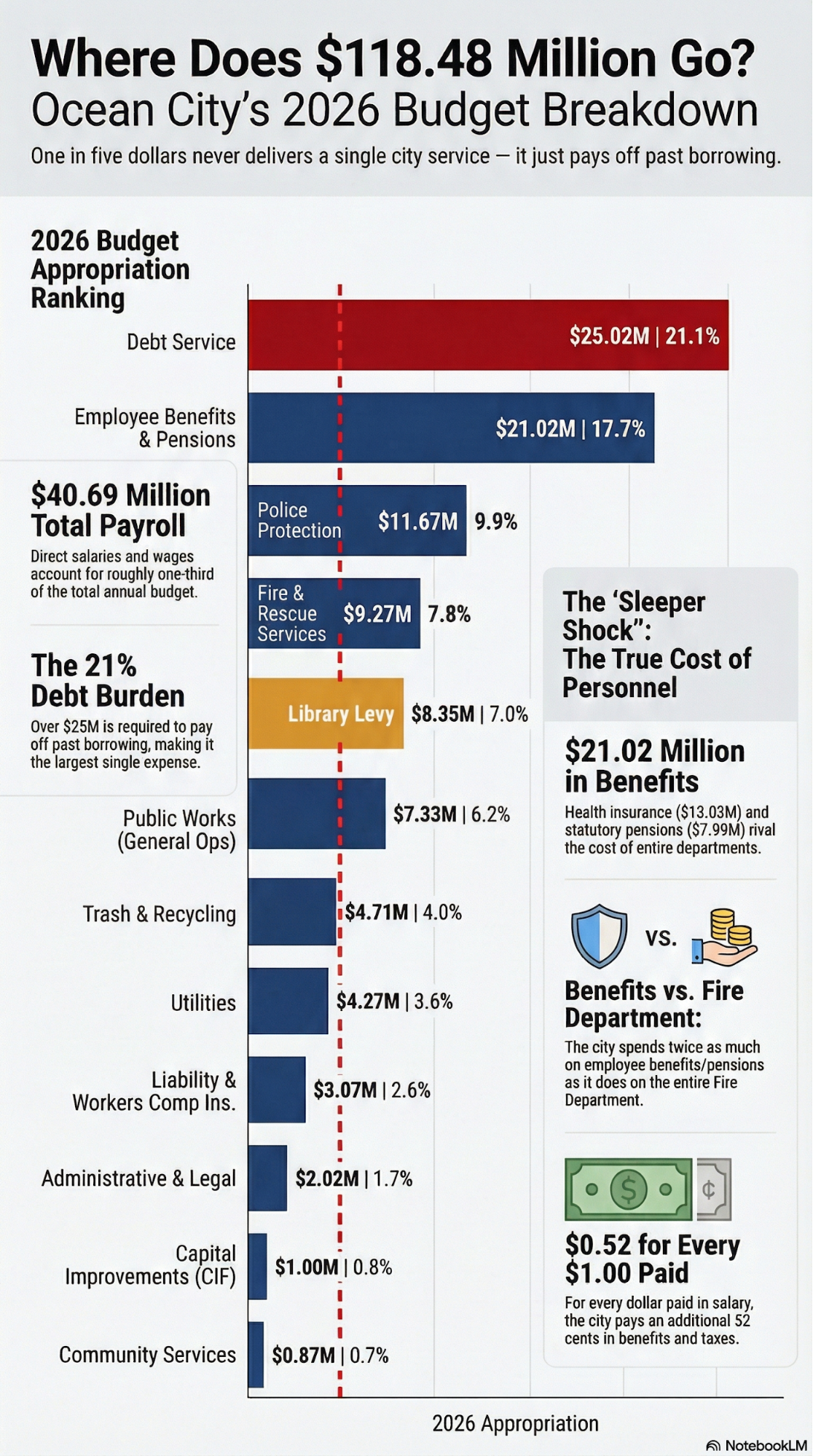
The 2026 budget breakdown is quite revealing. The city's single largest expense is debt service: $25.02 million, or 21.1% of the total. More than $1 in every $5 dollars goes to paying off past borrowing. The next largest category is employee benefits and pensions at $21.02 million, or 17.7%. Add in $40.69 million in total payroll and the cost of personnel dominates the ledger. For every dollar paid in salary, the city pays an additional 52 cents in benefits and taxes.
None of this is an argument against capital projects or essential services. We are a coastal town, and large capital projects are needed to protect our town from a variety of environmental issues. Police protection costs $11.67 million. Fire and rescue costs $9.27 million. Public works costs $7.33 million. Trash and recycling cost $4.71 million. These are real services people rely on.
But the broader point is this: a large share of the budget is consumed by debt, personnel costs, and fixed obligations. As this grows, the city’s strategic flexibility shrinks. So does its ability to handle cost increases in other areas, without raising taxes. This is what rating agencies look at, and Ocean City’s debt service is starting to get into a zone where those agencies start to get nervous.
That’s why increasing ratables does not automatically improve quality of life.
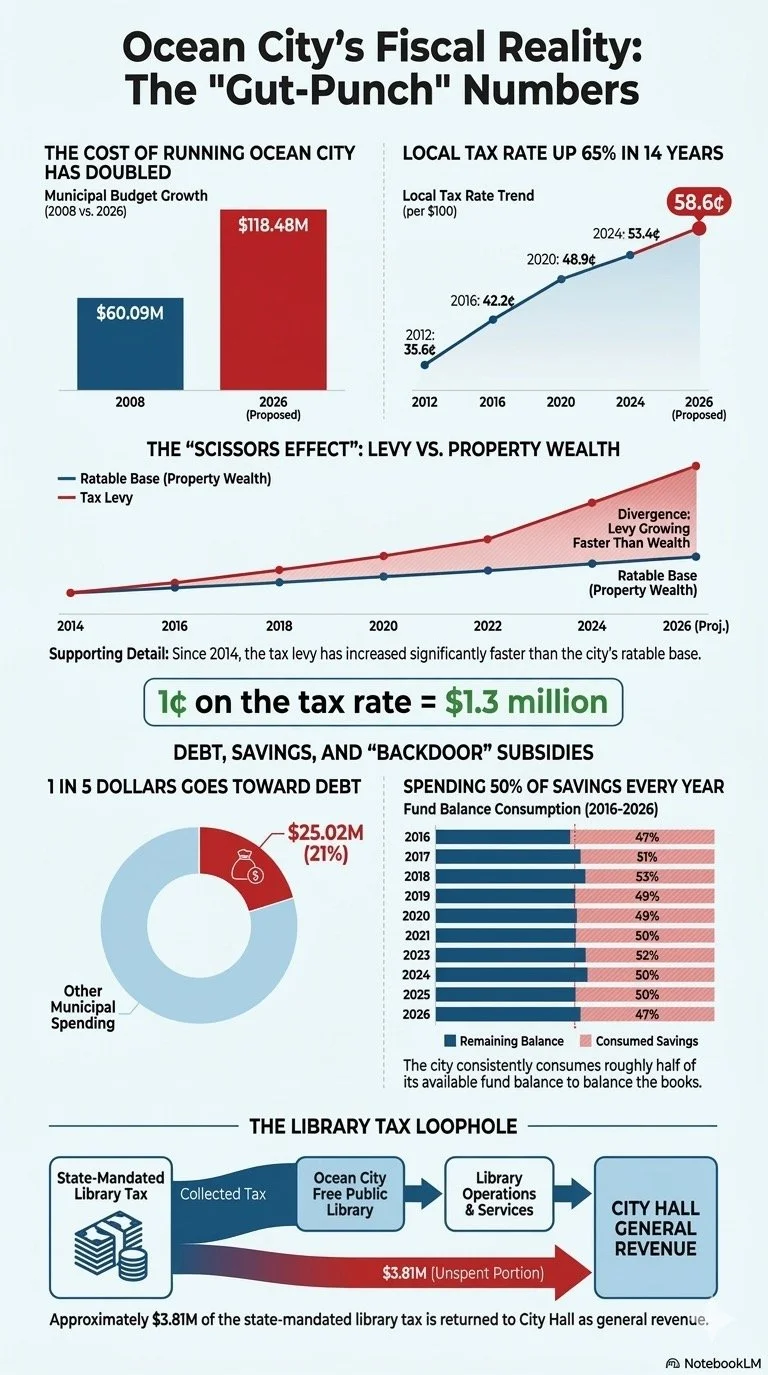
A larger tax base can help, but only if the budget, which can be impacted by development, does not grow faster than the ratable growth.
New development is not a magic piggy bank; it comes with cost. It creates infrastructure demands, traffic, parking pressure, sanitation needs, utility strain, and public safety costs. If the city's financial structure is already dominated by growing debt and overhead, new ratables get consumed by those costs and cannot be used to help pay for the rising cost of other things, like beach replenishment, city-sponsored events, and other things.
And if this development is in the form of second and third homes, or multi-family VRBO units, the added development won’t translate to more sales for local merchants, or create a more livable town in the off season as these homes go unoccupied much of the year.
In short, development, on its own and unconstrained, does not make the town more fiscally strong, or more livable. It needs to be paired with development that encourages a larger year round population, more livability (which may mean more constrained development) and rigorous budget discipline to match budget growth and ratable growth.
The numbers show we are not meeting that challenge. The tax levy has been rising faster than the city's ratable base since 2014. Even as property wealth increases, the city's revenue demands are increasing faster. In that environment, "more ratables" does not bring relief. It feeds a system that is already getting more expensive to sustain.
The library levy points to the same transparency problem. Taxpayers hear "dedicated tax" and naturally assume every dollar goes directly and cleanly to the service named on the label. But if a portion of that levy effectively frees up money elsewhere in the budget, the public has every right to ask harder questions about where its money is really going. That’s not an argument against the library. It’s an argument for clearer budgeting and more honest public accounting.
The city also appears to be relying heavily on fund balance, consuming roughly half of available reserves each year to balance the books. That may keep things afloat in the short term. It’s not the same as solving a structural problem.
The auto industry offers a useful parallel. Between 1980 and 2022, average new-vehicle fuel economy improved by about 33%. Real engineering progress. But over that same period, horsepower rose 144% and vehicle weight rose 33%. So engines got better. But designers spent that extra horsepower on bigger, heavier, and faster cars rather than cashing out on fuel savings.
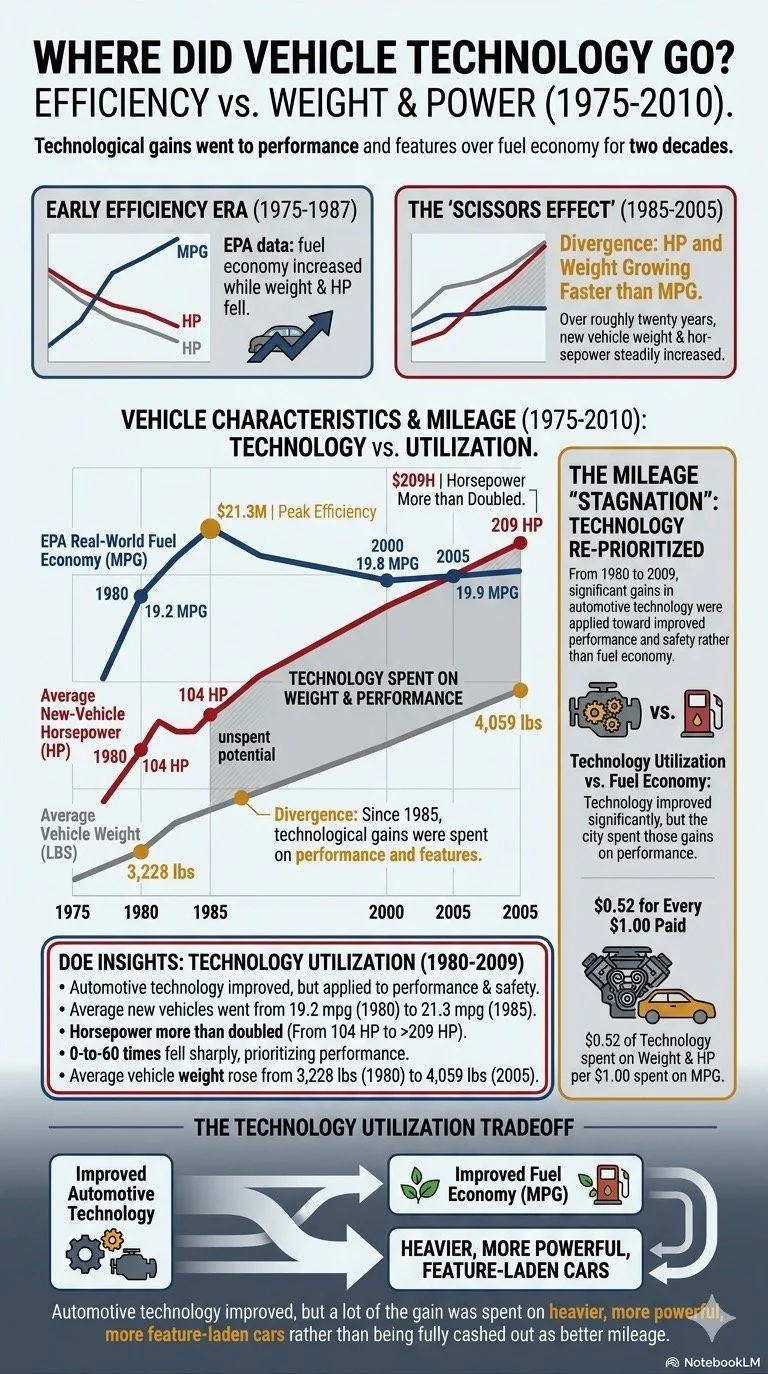
By 2005, average fuel economy had actually fallen back to 19.9 mpg from 21.3 mpg in 1985, even as average weight climbed from 3,220 to 4,059 pounds.
City budgets can work exactly the same way. A growing tax base should, in theory, create relief. But if government grows more expensive at a faster pace, the gain disappears into the machinery.
Quality of life is not the same thing as gross taxable value. A stronger Ocean City is not just one with more development on paper. It’s one where public spending produces visible civic value: better public spaces, safer streets, preserved neighborhood character, tighter sense of community and a town that still works for the people who are here year-round.
More ratables can be part of a healthy plan. But they’re not a plan by themselves. And they don’t compensate for the front porches they replace.
